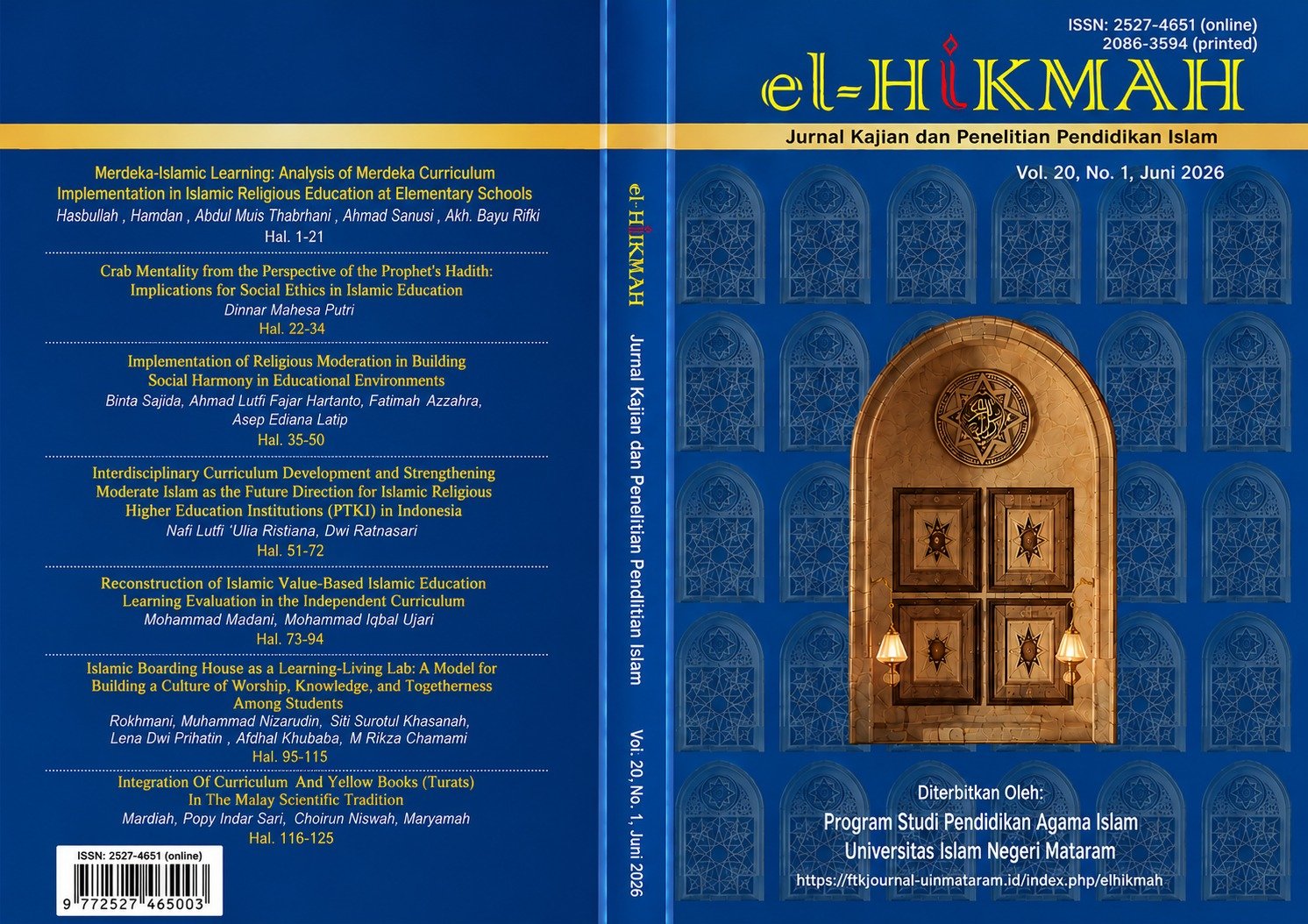
Interdisciplinary Curriculum Development and Strengthening Moderate Islam as the Future Direction for Islamic Religious Higher Education Institutions (PTKI) in Indonesia
DOI:
https://doi.org/10.20414/elhikmah.v20i1.14651Keywords:
PTKI, Interdisciplinary Curriculum, Integration of Knowledge, Moderate Islam, UINAbstract
The change of Islamic Religious Universities (PTKI) in Indonesia from State Islamic Religious Colleges (STAIN) and State Islamic Religious Institutes (IAIN) to State Islamic Universities (UIN) opens a new era for the development of science based on Islamic values. However, this institutional transformation has not been fully able to answer the challenges of globalization, digitalization, and increasing social and religious polarization. PTKI is required not only to produce graduates who excel academically, but also to have an inclusive, critical, and moderate religious character. This article aims to analyze the future direction of PTKI through two strategic pillars, namely the development of an interdisciplinary curriculum and the strengthening of moderate Islam. This research uses a literature study approach by examining various relevant scientific sources. The results of the study show that the integration of religious science and general science is not only to reduce the scientific dichotomy, but to build a complementary scientific and religious perspective. The interdisciplinary curriculum paradigm allows students to examine religious and social issues through various scientific perspectives, thereby encouraging academic dialogue, intellectual tolerance, and strengthening critical thinking. Other findings reveal that the internalization of wasathiyah values (religious moderation) will be more effective if it is not only taught through courses, but also instilled through campus ecosystems, academic culture, and scientific practices. This study recommends that PTKI strengthen the relevance of curriculum, learning innovation, and moderate academic culture as a strategy for developing Islamic education that is superior, inclusive, and globally competitive.
Downloads
References
Abdullah, M. A. (2012). Islamic Studies di Perguruan Tinggi: Pendekatan Integratif-Interkonektif. Pustaka Pelajar.
Abdullah, M. A. (2020a). Religion, Science, and Culture: An Integrated, Interconnected Paradigm of Science. SUKA Press.
Abdullah, M. Amin. (2020). Multidisiplin, Interdisiplin, dan Transdisiplin: Metode Studi Agama dan Studi Islam di Era Kontemporer. Yogyakarta: IB Pustaka.
Abdullah, M. A. (2020b). Religion, Science and Culture: An Integrated, Interconnected Paradigm of Science. Al-Jami’ah: Journal of Islamic Studies, 58(1), 1–33. https://doi.org/10.14421/ajis.2020.581.63-102
Achmad. (2025). Integration of Science in the Practice of Islamic Education in PTKI. International Journal of Islamic Education Discourse, 1–12. https://doi.org/10.59966/6nt3mw28
Afryansyah, A., Ismail, F., Ismail, I., Zuhdiyah, Z., & Nurbuana, N. (2025). The concept of intellectual development from the epistemological perspective of Islamic education. TOFEDU: The Future of Education Journal, 4(2), 26–31. https://doi.org/10.47709/ejim.v4i2.5140
Altbach, P. G. (2016). Global Perspectives on Higher Education. Baltimore: Johns Hopkins University Press.
Ashby, I., & Exter, M. (2019). Designing for interdisciplinarity in higher education. International Journal of Designs for Learning, 10(1). https://doi.org/10.14434/ijdl.v10i1.24122
Azra, A. (2012). Pendidikan Islam: Tradisi dan Modernisasi di Tengah Tantangan Milenium III. Kencana Prenadamedia Group.
Azra, A. (2020). Moderasi Islam di Indonesia: Dari Ajaran, Ibadah, hingga Peradaban. Kencana.
Baidhawy, Z. (2015). Pendidikan Islam Berwawasan Multikultural. Jakarta: Erlangga.
Baidhawy, Z. (2020). Building harmony and peace through multiculturalist theology-based religious education: An Indonesian experience. British Journal of Religious Education, 42(4), 1–15. https://doi.org/10.1080/01416200.2020.1712314
Barnett, R. (2021). The ecological university: A feasible utopia. Routledge. https://doi.org/10.4324/9781003138777
Booth, A., Sutton, A., & Papaioannou, D. (2021). Systematic Approaches to a Successful Literature Review (3rd ed.). Sage Publications.
https://doi.org/10.4135/9781529756547
Darbellay, F. (2020). Rethinking inter- and transdisciplinarity: Undisciplined knowledge and the emergence of a new thought style. Futures, 65. https://doi.org/10.1016/j.futures.2020.102617
Elo, S., Kaariainen, M., Kanste, O., Pokki, T., Utriainen, K., & Kyngas, H. (2014).
Qualitative content analysis: A focus on trustworthiness. SAGE Open, 4(1), 1–10.
https://doi.org/10.1177/2158244014522633
Hanif, A., Ma’mur, I., & Gunawan, A. (2024). From Tafaqquh Fiddin to Applied Sciences: The Transformation of Islamic Education in Indonesia. Khazanah Pendidikan Islam, 6(3), 385–399. https://doi.org/10.15575/kpi.v6i3.41500
Hefner, R. W. (2021). Islam and civic pluralism in Indonesia. Journal of Democracy, 32(2), 123–137. https://doi.org/10.1353/jod.2021.0020
Huda, M., & al., et. (2022). Reconstruction of Islamic education curriculum in the era of disruption. Educational Philosophy and Theory, 54(6), 1–13. https://doi.org/10.1080/00131857.2021.1987190
Huda, M., et al. (2022). Strengthening religious moderation through Islamic higher education in Indonesia. Education Sciences, 12(7). https://doi.org/10.3390/educsci12070456
Holley, K. A. (2020). Interdisciplinary curriculum and learning in higher education. Oxford Research Encyclopedia of Education. https://doi.org/10.1093/acrefore/9780190264093.013.138
Idris, T., Rijal, F., Irwandi, Hanum, R., & Mardhiah, A. (2024). A Multicultural Approach in Islamic Education Learning to Strengthen the Islamic Identity of Moderate Students in PTKIN Aceh. Tafkir: Interdisciplinary Journal of Islamic Education, 5(3), 478–493. https://doi.org/10.31538/tijie.v5i3.1138
Jannah, I., Gunagraha, S., & Baidi, B. (2025). Paradigma integrasi-interkoneksi ilmu agama dan sains dalam pemikiran Amin Abdullah. Tatar Pasundan: Jurnal Diklat Keagamaan, 19(1), 78–87. https://doi.org/10.38075/tp.v19i1.575
Jones, E., & Davies, S. (2021). Global citizenship and curriculum integration. Higher Education Research & Development, 40(3). https://doi.org/10.1080/07294360.2020.1822290
Kabir, R., Hayhoe, R., & Bai, A. C. M. (2023). The systematic literature review process: A simple guide for public health and allied health students. International Journal of Research in Medical Sciences.
Kementerian Agama RI. (2019). Moderasi Beragama. Jakarta: Kemenag RI.
Kementerian Agama RI. (2020). Roadmap Penguatan Moderasi Beragama. Jakarta: Kemenag RI.
Lattuca, L. R., Knight, D. B., & Bergom, I. (2021). Developing a measure of interdisciplinary competence. Research in Higher Education, 62. https://doi.org/10.1007/s11162-020-09594-z
Leask, B. (2020). Internationalization of the curriculum. Routledge. https://doi.org/10.4324/9780429320834
Marginson, S. (2018). High Participation Systems of Higher Education. Oxford: Oxford University Press.
Muhaimin. (2015). Pengembangan Kurikulum Pendidikan Agama Islam. Rajawali Pers.
Muna, M. W., & Fauzi, F. (2024). Konsep Kurikulum Pendidikan Islam Interdisipliner. Jurnal Bisnis Mahasiswa, 4(4), 795–806. https://doi.org/10.60036/jbm.v4i4.art29
Nata, A. (2016). Pendidikan Islam dalam Perspektif Sejarah, Pemikiran, dan Praktik. Kencana Prenadamedia Group.
Putri, L. A., Efendi, M., & Zalnur, M. (2025). Rekonstruksi epistemologi Islam: Integrasi bayani, burhani, dan irfani untuk resiliensi pengetahuan di era digital. Journal of Islamic Studies and Humanities, 10(1), 1–15. https://doi.org/10.21580/jish.v10i1.28841
Ramadhan, A. S. (2025). The relations between epistemology system of bayani, burhani, and irfani. ABHATS: Jurnal Islam Ulil Albab, 6(1), 1–12. https://doi.org/10.20885/abhats.vol6.iss1.art1
Sarmin, S., & Dewi, E. (2026). Epistemologi dalam pemikiran Islam: Analisis bayani, burhani, dan irfani. JIIP: Jurnal Ilmiah Ilmu Pendidikan, 9(2), 1512–1516. https://doi.org/10.54371/jiip.v9i2.10530
Saputra, A. H., Hermawan, H., & Priatna, T. (2024). Integrasi epistemologi keilmuan Islam dalam pengembangan kurikulum PAI pada sekolah. Educational Journal of Islamic Management, 4(2), 26–31. https://doi.org/10.47709/ejim.v4i2.5140
Shaffril, H. A. M., Samsuddin, S. F., & Samah, A. A. (2020). The ABC of systematic literature review: The basic methodological guidance for beginners. Quality & Quantity, 54, 1319–1346.
https://doi.org/10.1007/s11135-020-01059-6
Sholihah, N., Zainiyati, H. S., & Kholis, N. (2024). Utilizing Class Points in Islamic Religious Education With a Multidisciplinary Approach. Tafkir: Interdisciplinary Journal of Islamic Education, 5(2), 266–284. https://doi.org/10.31538/tijie.v5i2.888
Susiyati, & Sihono. (2024). Reformasi Perguruan Tinggi Keagamaan Islam Negeri: Menuju Pendidikan Berkualitas dan Berdaya Saing Global. Pendas: Jurnal Ilmiah Pendidikan Dasar, 10(1), 1–15. https://doi.org/10.23969/jp.v10i01.22400
Suyadi, & Sutrisno. (2020). A Paradigm of Islamic Education in the Disruption Era: Toward the Integration of Science and Religion. Journal of Social Studies Education Research, 11(1), 1–22. https://doi.org/10.17499/jsser.712313
Suyadi, & Sutrisno. (2020). “Rekonstruksi Pendidikan Islam di Era Disrupsi.” Jurnal Pendidikan Islam, 9(2), 123–140.
Zarkasyi, H. F. (2021). Integrasi Ilmu dalam Perspektif Islam: Kritik terhadap Dikotomi Keilmuan. Ponorogo: UNIDA Press.
Sya’adah, F., Munir, M., & Ismail, I. (2024). Epistemologi integratif bayani-burhani-irfani: Kerangka holistik kontemporer. Pendas: Jurnal Ilmiah Pendidikan Dasar, 10(4), 1–12. https://doi.org/10.23969/jp.v10i04.38060
Snyder, H. (2019). Literature review as a research methodology: An overview and guidelines. Journal of Business Research, 104, 333–339.
https://doi.org/10.1016/j.jbusres.2019.07.039
Vaismoradi, M., Turunen, H., & Bondas, T. (2020). Content analysis and thematic analysis: Implications for conducting a qualitative descriptive study. Nursing & Health Sciences, 22(3), 451–460.
https://doi.org/10.1111/nhs.12645
Wahyu, M. A., & M., A. (2025). Epistemologi dalam konsep Islam: Bayani, burhani, dan irfani. Lintekedu: Jurnal Literasi dan Teknologi Pendidikan, 6(2), 285–302.
Wardani, R. E. K., & Abidin, M. (2025). Integrasi agama dan sains dalam paradigma keilmuan: Analisis bayani, burhani, dan irfani. El-Fikr: Jurnal Aqidah dan Filsafat Islam, 6(2), 142–167. https://doi.org/10.19109/el-fikr.v6i2.32923
Xiao, Y., & Watson, M. (2019). Guidance on conducting a systematic literature review. Journal of Planning Education and Research, 39(1), 93–112.https://doi.org/10.1177/0739456X17723971
Downloads
Published
How to Cite
Issue
Section
License
Copyright (c) 2026 Authors and readers can copy and redistribute the material in any medium or format, as well as remix, transform, and build upon the material for any purpose, even commercially, but they must give appropriate credit (cite to the article or content), provide a link to the license, and indicate if changes were made. If you remix, transform, or build upon the material, you must distribute your contributions under the same license as the original.

This work is licensed under a Creative Commons Attribution-ShareAlike 4.0 International License.