
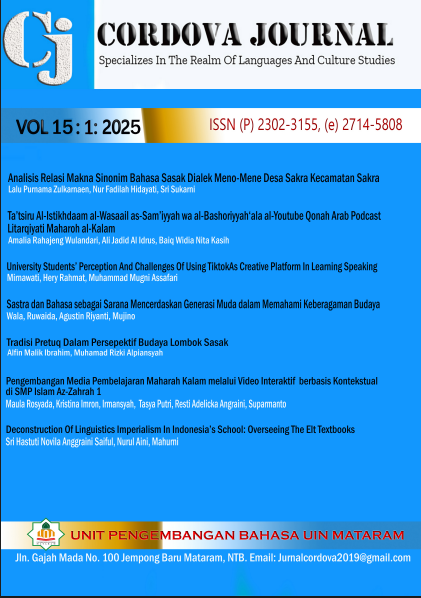
University Students’ Perception And Challenges Of Using Tiktok As Creative Platform In Learning Speaking
DOI:
https://doi.org/10.20414/cordova.v15i1.14097Abstract
TikTok, as a popular social media platform among the younger generation, offers a unique potential to support English language learning through interactive short video formats. This study aims to explore the perceptions of university students as well as the challenges faced regarding the use of TikTok as creative platform in learning speaking skills. This study uses a descriptive qualitative approach involving twenty-six fifth semester students as research subjects. Data were collected through open-ended questionnaire and interviews to understand students' perception and challenges regarding the use of TikTok as creative learning platform in improving students' speaking. The research results show that the majority of students have a positive perception of for TikTok as creative learning platform for its effectiveness and enjoying learning. This study also revealed several challenges faced by students, such as internet connection issues and data quota as well as difficulty in maintaining focus while studying. The research demonstrates how digital creative platforms like TikTok can enhance access to innovative and effective learning methods, support the development of essential language skills, and address challenges related to technology infrastructure.
Downloads
References
Agustin, N. (2021). Dampak pengunaan aplikasi TikTok terhadap karakter mahasiswa PGMI STAI Al-Azhar Menganti Gresik. Jurnal Primary (Kajian Ilmu Pendidikan Dasar dan Humaniora), 2(1), 45–52. Retrieved from https://ejournal.stkippgri-sidoarjo.ac.id/index.php/psd/article/download/346/248
Agustini, N. P. O. (2023). Penggunaan media tiktok dan teknik drama voice sebagai strategi terhadap kemampuan mahasiswa dalam berbahasa Inggris. JPPI (Jurnal Penelitian Pendidikan Indonesia), 9(4), 581-588. https://doi.org/10.29210/020233173
Aini, Q. (2023). Hubungan media sosial TikTok terhadap konsentrasi belajar siswa. At-Taujih: Jurnal Bimbingan dan Konseling Islam, 2(1), 1–12. https://doi.org/10.37216/taujih.v2i1.1212.
Anggreni, A., Rofiqoh, R., Maf’ulah, M. Lebagi, D., Dewi, A. K., & Patmasari, A. (2024). Edukasi pemanfaatan TikTok Duet sebagai media belajar Bahasa Inggris mandiri bagi guru-guru MAN Insan Cendekia Palu. Abdimas Indonesia, 4(3), 978–984. https://doi.org/10.53769/jai.v4i3.909
Assapari, M. M. (2019). The influence of CTL in teaching english speaking skill for adult learners: A case in Islamic Mataram State University Indonesia. Asian EFL Journal, 25(5), 6–15. Retrieved from https://repository.uinmataram.ac.id/125/1/AEJ-The%20Influence%20of%20CTL.pdf.
Assapari, M. M., & Hidayati, R. (2023). EFL speaking student readiness to use Mobile-Assisted Language Learning. LLT Journal: A Journal on Language and Language Learning, 26(1), 336–378. https://doi.org/10.24071/llt.v26i1.5240.
Awang, H., Mohd Khalid, M. A.S., Yin, A.W., & Ya’acob, C.H. (2023). The use of TikTok to enhance atudent participation in computer applications class. Journal of Contemporary Social Science and Education Studies (JOCSSES), 2(2), 30–40. https://doi.org/10.5281/zenodo.10199330
Bura, B. O., Balik, L. M., & Uran, S. I. G. (2025). Enhancing English speaking motivation of nursing students’ through mini vlogs on TikTok . EDUCATIONAL: Jurnal Inovasi Pendidikan & Pengajaran , 4(4), 502-509. https://doi.org/10.51878/educational.v4i4.4165.
Fadli, M. R. (2008). Memahami desain metode penelitian kualitatif. Humanika: Kajian Ilmiah Mata Kuliah Umum, 21(1), 33–54. https://doi.org/10.21831/hum.v21i1.
Fanaqi, C., Febrina, I. R., Pratiwi, R. M., & Gymnastiar, G. (2022). Pemanfaatan TikTok sebagai media edukasi di masa pandemi covid-19. Jurnal Komunikasi Universitas Garut: Hasil Pemikiran dan Penelitian 8(2), 910–924. https://doi.org/10.52434/jk.v8i2.2102.
Fauziyah, N., Ramadhini, A., Wardhana, K. E., & Hidayat, A. F. S. (2022). Penggunaan aplikasi TikTok sebagai media pembelajaran untuk meningkatkan minat belajar peserta didik di era globalisasi digital. Jurnal Tarbiyah dan Ilmu Keguruan Borneo, 3(3), 181-193. https://doi.org/10.21093/jtikborneo.v3i3.5925
Fitria, T. N. (2023). Using Tiktok Application As an English Teaching Media: a Literature Review. Journal of English Teaching, Applied Linguistics and Literatures (JETALL), 6(2), 109-124. https://doi.org/10.20527/jetall.v6i2.16058
Gou, P. (2023). Teaching English using mobile applications to improve academic performance and language proficiency of college students. Education and Information Technologies, 28(12), 16935–16949. https://doi.org/10.1007/s10639-023-11864-9
Herlisya, D., & Wiratno, P. (2022). Having Good Speaking English through Tik Tok Application. Journal Corner of Education, Linguistics, and Literature, 1(3), 191–198. https://doi.org/10.54012/jcell.v1i3.35
Laili, R. N. (2023). Students’ perspectives on using TikTok videos as a medium for learning English. Lunar, 7(2), 39–56. https://doi.org/10.36526/ln.v7i2.3098
Leong, L. & Ahmadi, S. M. (2017). An analysis of factors influencing learners’ English speaking skill. IJREE. 2(1), 34–41. Retrieved from
http://ijreeonline.com/article-1-38-en.html.
Lestari, M. I., & Andaryani, E. T. (2024). Minat dan keterampilan siswa dalam pembelajaran seni musik berbantuan tiktok di Sekolah Dasar. Pendas: Jurnal Ilmiah Pendidikan Dasar, 09(03), 473–447. https://doi.org/10.23969/jp.v9i3.15267
Liriwati, F. Y. (2023). Revolusi digital dan merdeka belajar: Meningkatkan daya saing siswa di era teknologi. Journal Innovation in Education (INOVED), 1(3), 221–231. https://doi.org/10.59841/inoved.v1i3.284
Nurawaliyah, M. N., & Sudarmaji, I. (2021). Pengaruh penggunaan TikTok dalam meningkatkan kosakata Bahasa Inggris siswa SMK. Pedagogy: Jurnal Ilmiah Pendidikan, 12(1). 92–100. https://doi.org/10.51747/jp.v12i1.2249.
Patty, J., & Noija, L. F. A. (2023). Social media revolution?: TikTok's impact on language. Jurnal Review Pendidikan dan Pengajaran (JRPP), 6, 937–945. https://doi.org/10.31004/jrpp.v6i4.20610.
Pratama, R. M. D., & Hastuti, D. P. (2023). TikTok in improving students’ speaking skills in the English for Business Course. Wanastra: Jurnal Bahasa dan Sastra, 15(1), 50–55. https://doi.org/10.31294/wanastra.v15i1.15627
Rahmat, H., & Jon, R. B. (2023). Benefits and challenges of group discussion as creative learning strategies in speaking class. IJECA (International Journal of Education and Curriculum Application), 6(1), 72. https://doi.org/10.31764/ijeca.v6i1.13804
Sarkila, D., Islam, M. H. & Fatmawati, R. (2024). Students perception on the use of TikTok for learning speaking English. Fonologi?: Jurnal Ilmuan Bahasa dan Sastra Inggris, 2(2), 1–14. https://doi.org/10.61132/fonologi.v2i2.577.
Sukmojati, E., Ribahan, R., & Rahmat, H. (2023). Strategies and Challenges in Teaching Speaking by English Tutors: A Study in Madani Super Camp English Classes. JELITA: Journal of Education, Language Innovation, and Applied Linguistics, 2(2), 111–121. https://doi.org/10.37058/jelita.v2i2.7791
Suwanda, B. S., Harmanto, B., Maghfiroh, A., & Shohenuddin, S. (2024). TikTok Trick: Improving Students’ Pronunciation of Indonesian Migrant Workers Children in Malaysia. Journal of Languages and Language Teaching, 12(2), 974-984. https://doi.org/10.33394/jollt.v12i2.10869
Warini, N. L., Dewi, N. P. E. S., Susanto, P. C., & Dewi, P. C. (2021). Daya tarik TikTok sebagai media pembelajaran bahasa Inggris online. Prosiding Seminar Ilmiah Nasional Teknologi, Sains, dan Sosial Humaniora (SINTESA), 3 (November), 27–34. https://doi.org/10.36002/snts.v0i0.1230
Waruwu, M. (2023). Pendekatan Penelitian Pendidikan: Metode Penelitian Kualitatif, Metode Penelitian Kuantitatif dan Metode Penelitian Kombinasi (Mixed Method). Bhineka Tunggal Ika: Kajian Teori dan Praktik Pendidikan PKn, 7(1), 2896–2910. https://doi.org/10.31004/jptam.v7i1.6187.
Widagsa, R., & Fokatea, M. R. (2024). Learning English from TikTok: A Qualitative Case Study. Journal of English Language Teaching and English Linguistics, 9(2). 11–23. Retrieved from https://journal.upy.ac.id/index.php/eltics/article/view/6950
Yuhana, A. N., & Aminy, F. A. (2019). Optimalisasi Peran Guru Pendidikan Agama Islam Sebagai Konselor dalam Mengatasi Masalah Belajar Siswa. Jurnal Penelitian Pendidikan Islam, 7(1), 79-96. https://doi.org/10.36667/jppi.v7i1.357
Additional Files
Published
Issue
Section
License
Copyright (c) 2025 Hery Rahmat, Mirnawati Mirnawati, Muhammad Mugni Assapari

This work is licensed under a Creative Commons Attribution-NonCommercial-ShareAlike 4.0 International License.

is licensed under a Creative Commons Attribution-ShareAlike 4.0 International License


