
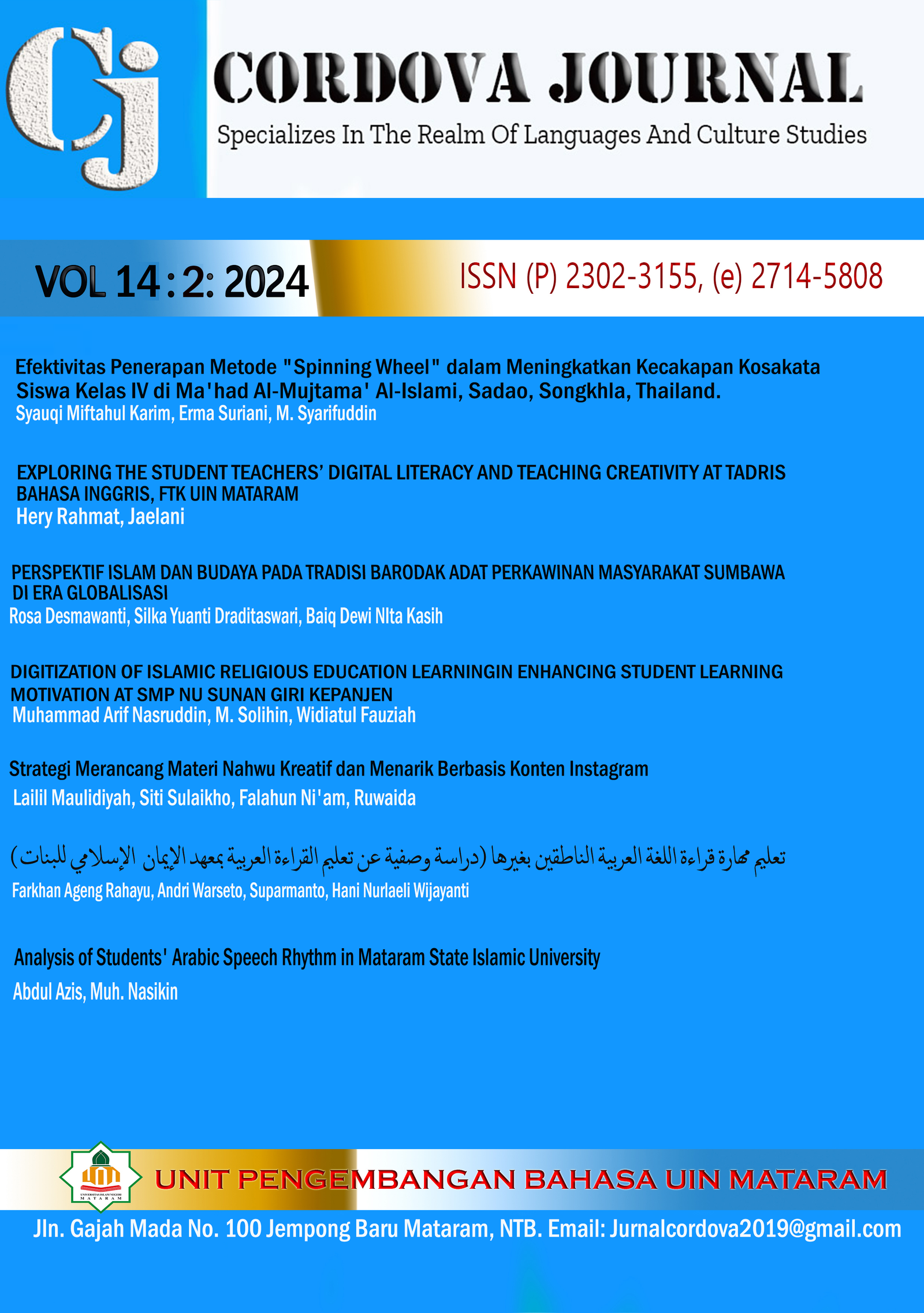
Exploring The Student Teachers’ Digital Literacy And Teaching Creativity At Tadris Bahasa Inggris, FTK UIN Mataram
DOI:
https://doi.org/10.20414/cordova.v14i2.11782Abstract
Teaching Practice Program (PPL) contributes to the development of professional teachers by educating and training the students in practice at schools. Though, some students still lack confidence and are perplexed when they teach in a real classroom setting. This study aims to find out the student teachers at Tadris Bahasa Inggris (TBI), FTK UIN Mataram Digital Literacy level, their Teaching Creativity, and the correlation between the two variables during the Teaching Practice Program. This research is a quantitative approach that used a descriptive correlational design with two variables namely Digital Literacy Level (X) and Teaching Creativity Index (Y). The population of this research is 122 student teachers of the sixth semester enrolled in the Teaching Practice (PPL) course program with 82 students as sample. The researchers use two-part questionnaires namely Digital Literacy scale suggested by Amin et al. (2021) with 27 items and Dikici & Soh's (2015) Creativity Fostering Teacher Behaviour Index (CFTIndex) with 28 items. The research found that (1) The student teachers’ Digital Literacy is 0.722 or 72.2 % or high Category; (2) The student teachers’ Creativity Teaching is 0.7203 or 72.03 % or high Category; and (3) There is a significant correlation between the Digital Literacy and Teaching Creativity at TBI, FTK, UIN Mataram. It is indicated that rtable > rcount (0.522 > 0.213) so that H0 is rejected and Ha is accepted. As it is compared to the coefficient of the interval from 0.40-0.599, the correlation has a level medium relationship.
Downloads
References
Amin, H., Malik, M. A., & Akkaya, B. (2021). Development and Validation of Digital Literacy Scale (XS) and its Implication for Higher Education. International Journal of Distance Education and E- Learning (IJDEEL) Volume VII-Issue I. 24-43.
Anisimova, E. (2020). Digital Literacy of Future Preschool Teachers. Journal of Social Studies Education Research, 11(1), 230-253. Retrieved November 20, 2024 from https://www.learntechlib.org/p/216438/.
Asari, A., Kurniawan, T., Ansor, S., & Putra, A. B. N. R. (2019). Kompetensi literasi digital bagi guru dan pelajar di lingkungan sekolah kabupaten Malang. BIBLIOTIKA: Jurnal Kajian Perpustakaan dan Informasi, 3(2), 98-104. http://dx.doi.org/10.17977/um008v3i22019p98-104
Beghetto, R. A. (2006). Does creativity have a place in classroom discussions? Prospective teachers’ response preferences. Thinking Skills and Creativity, 2(1), 1–9.
Bezemer, J., & Kress, G. (2016). Multimodality, learning and communication: A social semiotic frame. London: Routledge.
Cayirdag, N. (2017). Creativity fostering teaching: Impact of creative self-efficacy and teacher efficacy. Kuram ve Uygulamada Egitim Bilimleri, 17(6), 1959–1975. https://doi.org/10.12738/estp.2017.6.0437
Dikici, A., & Soh, K. (2015). Indexing Creativity Fostering Teacher Behaviour: Replication and Modification. Higher Education of Social Science, 9(3), 1-10. http://dx.doi.org/10.3968/7486
Durriyah, T.L. & Zuhdi, M. (2018). Digital literacy with student teachers: Exploring Indonesian student teachers’ initial perception about integrating digital technologies into a teaching unit. International Journal of Education and Literacy Studies 6(3): 53-60. https:doi.org/10.7575/aiac.ijels.v.6n.3p.53
Falloon, G. (2020). From digital literacy to digital competence: the teacher digital competency (TDC) framework. Educational Technology https://doi.org/10.1007/s11423-020-09767-4.
Febriandar, E. I. (2018). Pengaruh Kreativitas Pendidik Dalam Menerapkan Ice Breaking Dan Motivasi Belajar Terhadap Hasil Belajar Siswa Sekolah Dasar. Briliant: Jurnal Riset dan Konseptual, 3(4), 498. https://doi.org/10.28926/briliant.v3i4.253
Herawati, R., Mujahidin, E., & Hamat, A. A. (2019). Hubungan Motivasi dan Kreativitas Pendidik dalam Mengajar dengan Hasil Belajar Mata Pelajaran PAI di Madrasah Aliyah Negeri 4 Bogor. Jurnal Teknologi Pendidikan, 8(2), 235-246. https://doi.org/10.32832/tek.pend.v8i2.1507
Juandi, A., & Sontani, U. T. (2017). Keterampilan Dan Kreativitas Mengajar Pendidik Sebagai Determinan Terhadap Prestasi Belajar Siswa. Jurnal Pendidikan Manajemen Perkantoran, 2(2), 130. https://doi.org/10.17509/jpm.v2i2.8114
Kennedy, T. J., & Sundberg, C. W. (2020). 21st century skills. In Akpan, B. & Kennedy, T. J. (Eds). Science Education in Theory and Practice: An Introductory Guide to Learning Theory. Springer, Cham.
Kurniawati, N., Maolida, E. H., & Anjaniputra, A. G. (2018). The praxis of digital literacy in the EFL classroom: Digital-immigrant vs digital-native teacher. Indonesian Journal of Applied Linguistics, 8(1), 28–37. https://doi.org/10.17509/ijal.v8i1.11459
McGarr, O., & McDonagh, A. (2021). Exploring the digital competence of pre-service teachers on entry onto an initial teacher education programme in Ireland. Irish Educational Studies, 40(1), 115-128. https://doi.org/10.1080/03323315.2020.1800501
Muzaini, M., Rahayuningsih, S., Nasrun, N., & Hasbi, M. (2021). Creativity in synchronous and asynchronous learning during the covid-19 pandemic: A case study. AKSIOMA: Jurnal Program Studi Pendidikan Matematika, 10(3), 1722-1735. http://dx.doi.org/10.24127/ajpm.v10i3.3897
Pentury, H. J. (2017). Pengembangan kreativitas guru dalam pembelajaran kreatif pelajaran Bahasa Inggris. Faktor: Jurnal Ilmiah Kependidikan, 4(3), 265-272. http://dx.doi.org/10.30998/fjik.v4i3.1923
Rasam, F., & Sari, A. I. C. (2018). Peran Kreativitas Pendidik dalam Penggunaan Media Belajar dan Minat Belajar dalam Meningkatkan Prestasi Belajar Peserta Didik SMK di Jakarta Selatan. Research and Development Journal of Education, 5(1), 95-113. https://doi.org/10.30998/rdje.v5i1.3391
Rizal, R., Setiawan, W., & Rusdiana, D. (2019). Digital literacy of preservice science teacher. Journal of Physics: Conference Series, 1157(2). https://doi.org/10.1088/1742-6596/1157/2/022058
Suharyati, H., Laihad, G. H. & Suchyadi, Y. (2019). Development of Teacher Creativity Models to Improve Teacher’s Pedagogic Competency in the Educational Era 4.0. International Journal of Innovation, Creativity and Change, 5(6), 919–929.
Susilo, H. Sudrajat, A. K. & Rohman, F. (2021). The importance of developing creativity and communication skills for teacher: Prospective teacher students’ perspective. Proceeding of the 4th international conference on mathematics and science education (ICOMSE) 2020: Innovative research in science and mathematics education in the disruptive era. Malang, 25–26 August 2020
Additional Files
Published
Issue
Section
License
Copyright (c) 2024 Hery Rahmat, Jaelani

This work is licensed under a Creative Commons Attribution-NonCommercial-ShareAlike 4.0 International License.

is licensed under a Creative Commons Attribution-ShareAlike 4.0 International License


