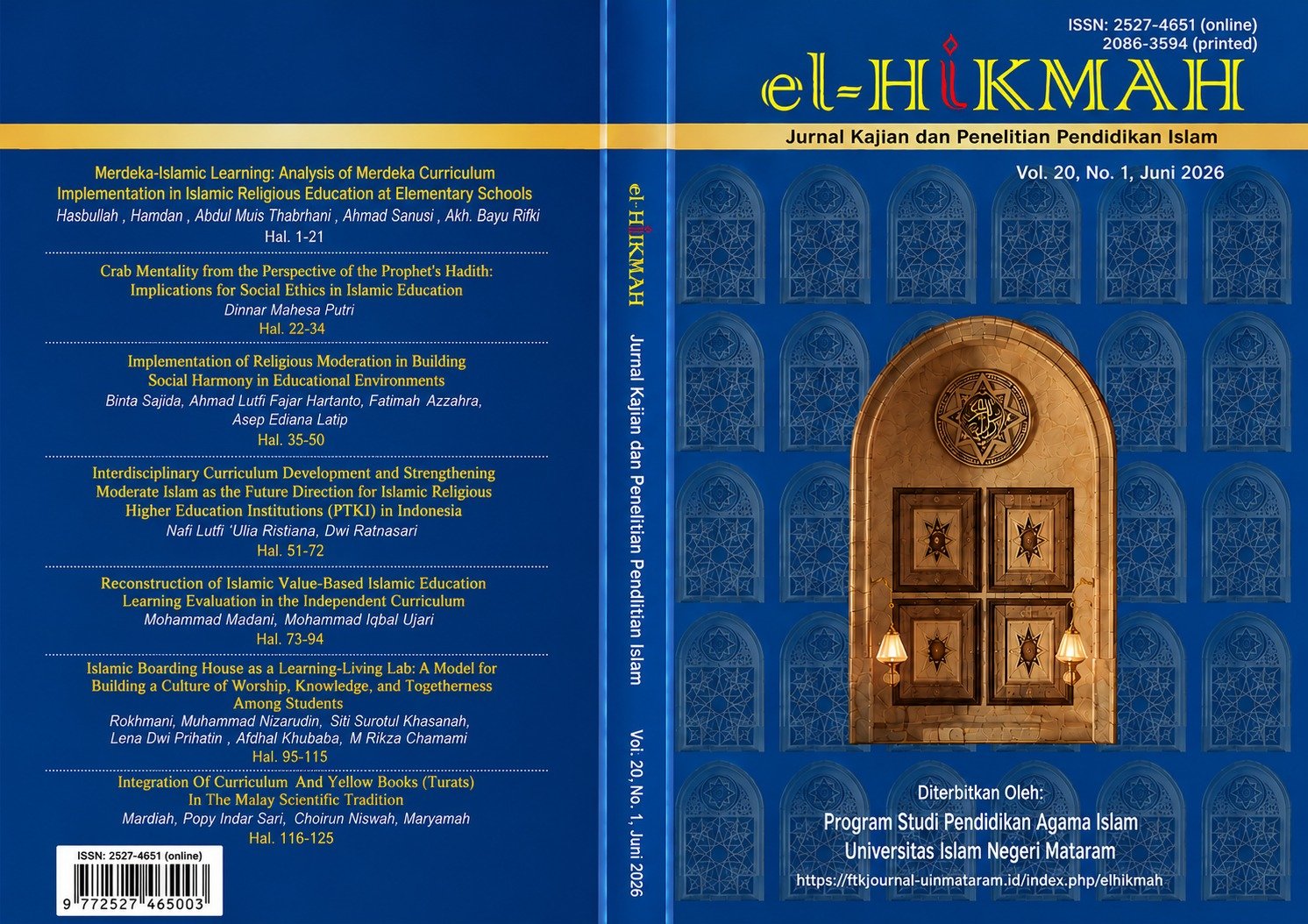
Crab Mentality from the Perspective of the Prophet's Hadith: Implications for Social Ethics in Islamic Education
DOI:
https://doi.org/10.20414/elhikmah.v20i1.14750Keywords:
Crab Mentality, Prophetic Hadith, Social Ethics, Islamic EducationAbstract
The phenomenon of crab mentality is a form of social behavior characterized by the tendency to hinder and undermine the success of others, which often appears in various social relationship contexts, including in educational environments. In educational practice, such attitudes have the potential to weaken the value of togetherness, damage the academic climate, and hinder the character-building process of students. This article aims to analyze the phenomenon of crab mentality from the perspective of the Prophet's hadith and examine its implications for social ethics in Islamic education. This research uses a qualitative approach thru library study with the thematic hadith method (maudhu'i). The primary data sources come from hadiths relevant to the themes of social relations, envy, and brotherhood in Sunan At-Tirmidhi and Sunan Abu Dawud, while the secondary sources include hadith commentary books and related scientific literature. The analysis results show that the Prophet's hadiths explicitly criticize envy, hatred, and actions that disrupt social harmony, which are substantially in line with the characteristics of crab mentality. These findings affirm that the social ethical values in hadith are of significant relevance to Islamic education, particularly in fostering a healthy academic culture, fair competition, and educational relationships based on empathy and mutual respect.
Downloads
References
Abu Dawud, S. ibn al-Ash‘ath. (2009). Sunan Abi Dawud. Dar al-Risalah al-‘Alamiyyah.
Al-‘Asqalani, A. ibn ‘A. ibn Hajar. (2018). Fath al-Bari: Commentary on Sahih al-Bukhari. Dar al-Ma‘rifah.
Al-Attas, S. M. N. (1991). The concept of education in Islam: A framework for an Islamic philosophy of education. Kuala Lumpur: ISTAC.
Al-Ghazali, A. H. (2020). Ihya’ ‘ulum al-din. Dar al-Kutub al-‘Ilmiyyah.
Al-Nawawi. (2013). Riyad al-Salihin. Beirut: Dar al-Kutub al-‘Ilmiyyah.
Amirudin. (2023). Metode-metode Mengajar Perspektif Al-Qur’an Hadits dan Aplikasinya dalam Pembelajaran PAI. Yogyakarta: CV Budi Utama.
Ardiansyah, I., & Iskandar. (2024). Contribution of educational psychology to the development of the Islamic education curriculum. IHSAN: Jurnal Pendidikan Islam, 2(1), 100–110. https://doi.org/10.61104/ihsan.v2i1.120
At-Tirmidhi, M. ibn ‘I. (2014). Sunan At-Tirmidhi. Dar al-Gharb al-Islami.
Aziz, A. (2022). Jealousy in the perspective of hadith and its impact on social relations. Hawari: Journal of Islamic Studies, 4(2), 145–160.
Basri, H. (2020). Ethical values in Islamic education: A hadith-based approach. Journal of Islamic Education Studies, 7(1), 23–38.
Biesta, G. (2015). The beautiful risk of education. Boulder, CO: Paradigm Publishers.
Dweck, C. S. (2006). Mindset: The new psychology of success. New York: Random House.
Efendi, R. M. (2025). Analysis of factors affecting learning from the perspective of Islamic educational psychology. Jurnal Kajian Ilmu Manajemen, 5(1).
Ekosistem Pendidikan Dalam Perspektif Al-Qur’an. (2023). Repository PTIQ Jakarta.
Festinger, L. (1954). A theory of social comparison processes. Human Relations, 7(2), 117–140.
Hakim, L. (2025). The Epistemology of Sunnah as a Pillar of Transformative Curriculum in Islamic Education: A Thematic Study of Scientific Hadith. Ejournal IAIN Kerinci.
Halstead, J. M. (2004). An Islamic concept of education. Comparative Education, 40(4), 517–529.
Hattie, J. (2009). Visible learning: A synthesis of over 800 meta-analyses relating to achievement. London: Routledge.
Huda, M. (2021). Social ethics in Prophetic hadith: A thematic analysis of brotherhood. Hikmah: Journal of Islamic Studies, 18(1), 1–17.
Implementasi Metode Cerita Tentang Kisah Tauladan Rasulullah dalam Menanamkan Akhlak Sesuai Al-Qur’an dan Hadist pada Siswa-Siswi MA Nurul Akhlak Biaro-Baru. (2024). Jurnal UM B.
Internalisasi Nilai Hadis Nabi SAW sebagai Strategi Pendidikan Efektif Mengatasi Kenakalan Remaja melalui Analisis Maudu‘i Kontemporer. (2025). Ejournal UIN Bukittinggi.
Ismail, N., & Aminah, S. (2023). Jealousy and social harmony in Islamic perspective. Al-Bukhari: Journal of Hadith Studies, 6(2), 89–104.
Kamali, M. H. (2017). The middle path of moderation in Islam: The Qur’anic principle of wasatiyyah. Oxford: Oxford University Press.
Konsep Pola Pendidikan Rasulullah SAW sebagai Model Pendidikan Karakter di Indonesia. (2025). E-Theses IAIN Curup.
Latif, A. (2022). The principle of “no harm” (la darar wa la dirar) in Prophetic traditions. Journal of Hadith and Islamic Law, 5(2), 67–82.
Mahmud, A. (2021). Competition and moral education in Islamic pedagogy. International Journal of Islamic Educational Thought, 4(1), 45–60.
Mahmud, A. (2021). Pendidikan karakter berbasis nilai Islam. Yogyakarta: Pustaka Pelajar.
Nilai Tawadhu Rasulullah dalam Budaya Akademik Kampus. (2021). S3 Pendidikan Dasar FIP UNESA.
Nugroho, A., & Fauziah, L. (2023). Crab mentality and academic culture: A social ethics perspective. Journal of Social and Educational Studies, 9(2), 101–115.
Pembelajaran 101 Hadits Budi Luhur Melalui Pendekatan Authentic Instruction. (2025). DOAJ.
Pendidikan Karakter dalam Perspektif Hadis Nabi SAW. (2016). Digilib UINSA.
Penggunaan Strategi Pembelajaran Kooperatif dalam Meningkatkan Partisipasi Siswa pada Mata Pelajaran Pendidikan Agama Islam. (2023). Crossref.
Rahman, F. (2021). Social ethics in Islam: Qur’anic and hadith perspectives. Prenadamedia Group.
Saeed, A. (2016). Islamic ethics: An introduction. Routledge.
Saeed, A. (2016). Islamic thought: An introduction. London: Routledge.
Syamsuddin, S. (2020). Thematic hadith research methodology. Pustaka Pelajar.
The Use of Hadith in Islamic Boarding School Education. (2026). Zenodo.
Urgensi Keteladanan Dalam Pendidikan Islam dan Relevansinya dengan Hadits Ibda Binafsik. (2021). OPAC UIN K.H. Abdurrahman Wahid Pekalongan.
Zainuddin, M. (2024). Character education in Islamic institutions: Ethical challenges and opportunities. Journal of Islamic Educational Research, 8(1), 1–15.
Zins, J. E., Weissberg, R. P., Wang, M. C., & Walberg, H. J. (2004). Building academic success on social and emotional learning. New York: Teachers College Press.
Downloads
Published
How to Cite
Issue
Section
License
Copyright (c) 2026 Authors and readers can copy and redistribute the material in any medium or format, as well as remix, transform, and build upon the material for any purpose, even commercially, but they must give appropriate credit (cite to the article or content), provide a link to the license, and indicate if changes were made. If you remix, transform, or build upon the material, you must distribute your contributions under the same license as the original.

This work is licensed under a Creative Commons Attribution-ShareAlike 4.0 International License.