
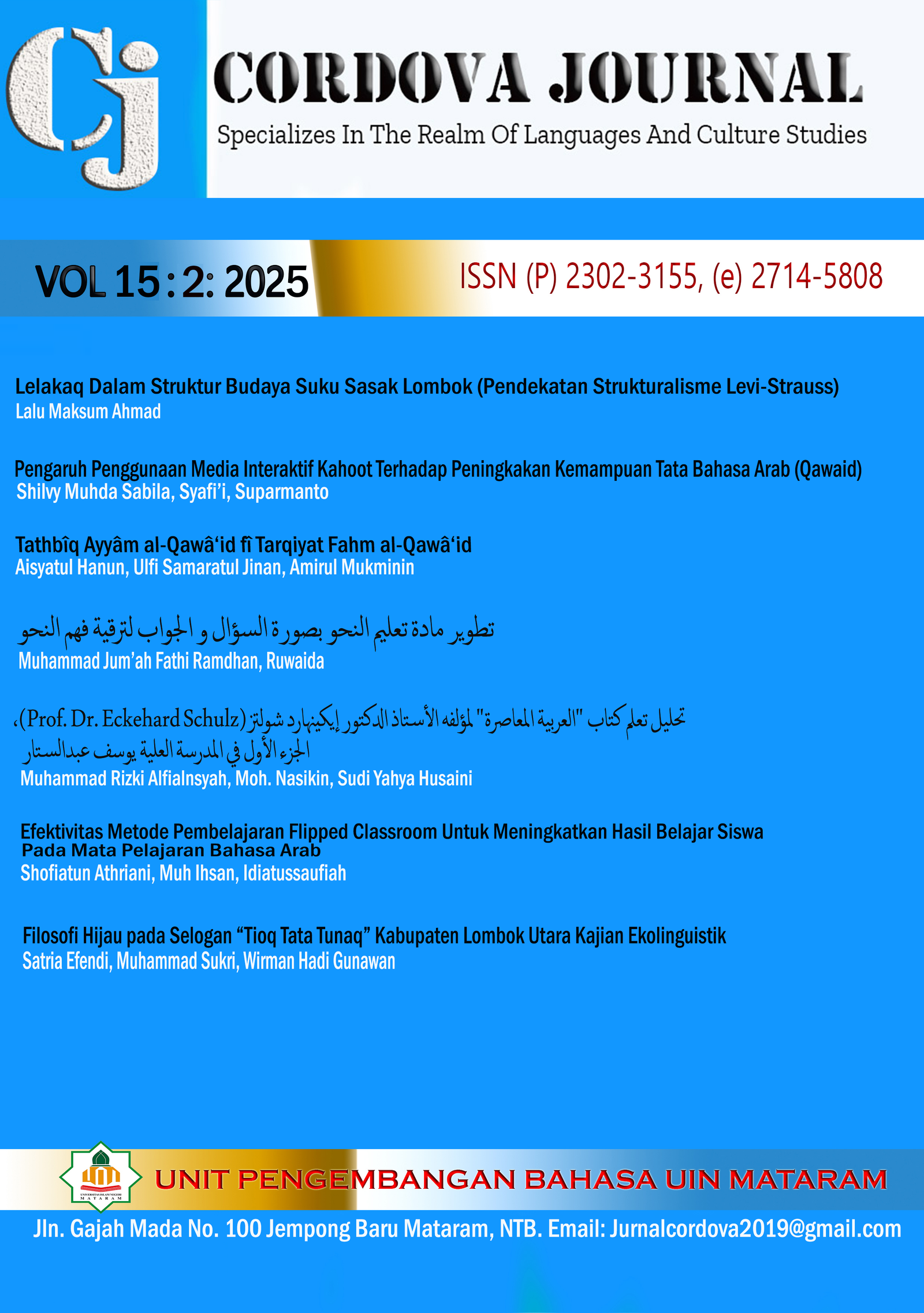
Filosofi Hijau Pada Selogan "Tioq Tata Tunaq" Kabupaten Lombok Utara
DOI:
https://doi.org/10.20414/cordova.v15i2.9134Abstract
Apart from being a medium of communication, language also has various functions, one of them as a suggestion tool. There are various multi-disciplines related to language, such as sociolinguistics, psycholinguistics, and so on. There is also the term Eco-linguistics which connects the influence of language with the human biological environment. The slogan "Tioq Tata Tunaq" in North Lombok is the object of the researcher's study in this paper. It is felt that the slogan has a philosophical view of environmental preservation. Until now, there has been no research related to the philosophical content of the slogan "Tioq Tata Tunaq" related to environmental conservation. Therefore, the researcher has studied the slogan using an Eco-linguistic theory approach, with a dialectical linguistic method, parsing the discourse contained in each word listed in the "Tioq Tata Tunaq" slogan by finding inter-textual, intra-textual, and extra-textual elements. Besides, it also parses the key morphemes in the slogan. The researcher found that there is a close connection between the slogan "Tioq Tata Tunaq" and the preservation of the biological environment. After analyzing, the researcher found that each key of morpheme in the slogan directs its meaning to matters related to green philosophy (nature conservation). So it can be said that the slogan "Tioq Tata Tunaq" contains the philosophy of preserving nature or the biological environment.
Keyword: Eco-linguistics, Tioq Tata Tunaq, Green Philosophy, Language, Natural Environment, Biology
Downloads
References
Bang, J.Chr. dan Door, J. (1993). EcoLinguistics: A Framework. [online] Dapat diakses lewat situs:
Bang, J. Chr. dan Door, J. (1996). Language, Ecology, and Truth – Dialogue and Dialectics. [online] Dapat diakses lewat situs: www.pdfio.com/k-22479.html
Bundsgaard, Jeppe dan Sune Steffensen. (2000). ”The Dialectics of Ecological Morphology - or the Morphology of Dialectics”. Dalam Anna Vibeka Lindo dan Jeppe Bundsgaard (eds.) Dialectal Ecolinguistics: Three Essays for the Symposium 30 Years of Language and Ecology in Graz, December 2000. University of Odense
Subiyanto Agus. (2013). “Ekolinguistik: Model Analisis dan Penerapannya” HUMANIKA, vol. 18, no. 2, Jul. https://doi.org/10.14710/humanika.18.2.
Kantor Bahasa NTB. (2017). Kamus Bahasa Sasak-Indonesia. Kementerian Pendidikan RI
BPS Lombok Utara. (2019). Data Lombok Utara
Profil Kabupaten Lombok Utara. (2022). Lombok Utara Dalam Data
Akib Muhammad. (2016). Hukum Lingkungan Perspektif Global dan Nasional. Jakarta: PT. Grafindo Persada
Amsyari Fuad. (1997). Prinsip-prinsip Masalah Pencemaran Lingkungan. Jakarta: Ghalia Indonesia
Halliday, M.A.K. (2001). “New Ways of Meaning: The Challenge to Applied Linguistics”. Dalam Fill, A. dan Muhlhausler, P. The Ecolinguistics Reader: Language, Ecology, and Environment. London: Continuum
Haugen, E. (1972). “The Ecology of Language”. dalam Dil, A.S. (ed) The Ecology of Language: Essays by Einar Haugen. Stanford: Stanford University Press.
Haugen, E. (1972). “The Ecology of Language”. Dalam Fill, A. dan Muhlhausler, P. The Ecolinguistics Reader: Language, Ecology, and Environment. London: Continuum.
Steffensen, Sune Vork. (2007). “Language, Ecology and Society: An Introduction to Dialectical Linguistics”. Dalam Steffensen, S.V dan J. Nash (Eds). Language, Ecology and Society – a Dialectal Approach. London: Continuum.
Fox James. (2021). Dari Alam hingga Gerakan Lingkungan, Menelusuri Asal-usul Warna Hijau. Jakarta: BBC Indonesia. Situs bisa dikunjugi di https://www.bbc.com/indonesia/vert-cul-59236573
Additional Files
Published
Issue
Section
License
Copyright (c) 2025 Satria Efendi, Dr. Muhammad Sukri, M.Hum.,

This work is licensed under a Creative Commons Attribution-NonCommercial-ShareAlike 4.0 International License.

is licensed under a Creative Commons Attribution-ShareAlike 4.0 International License


