
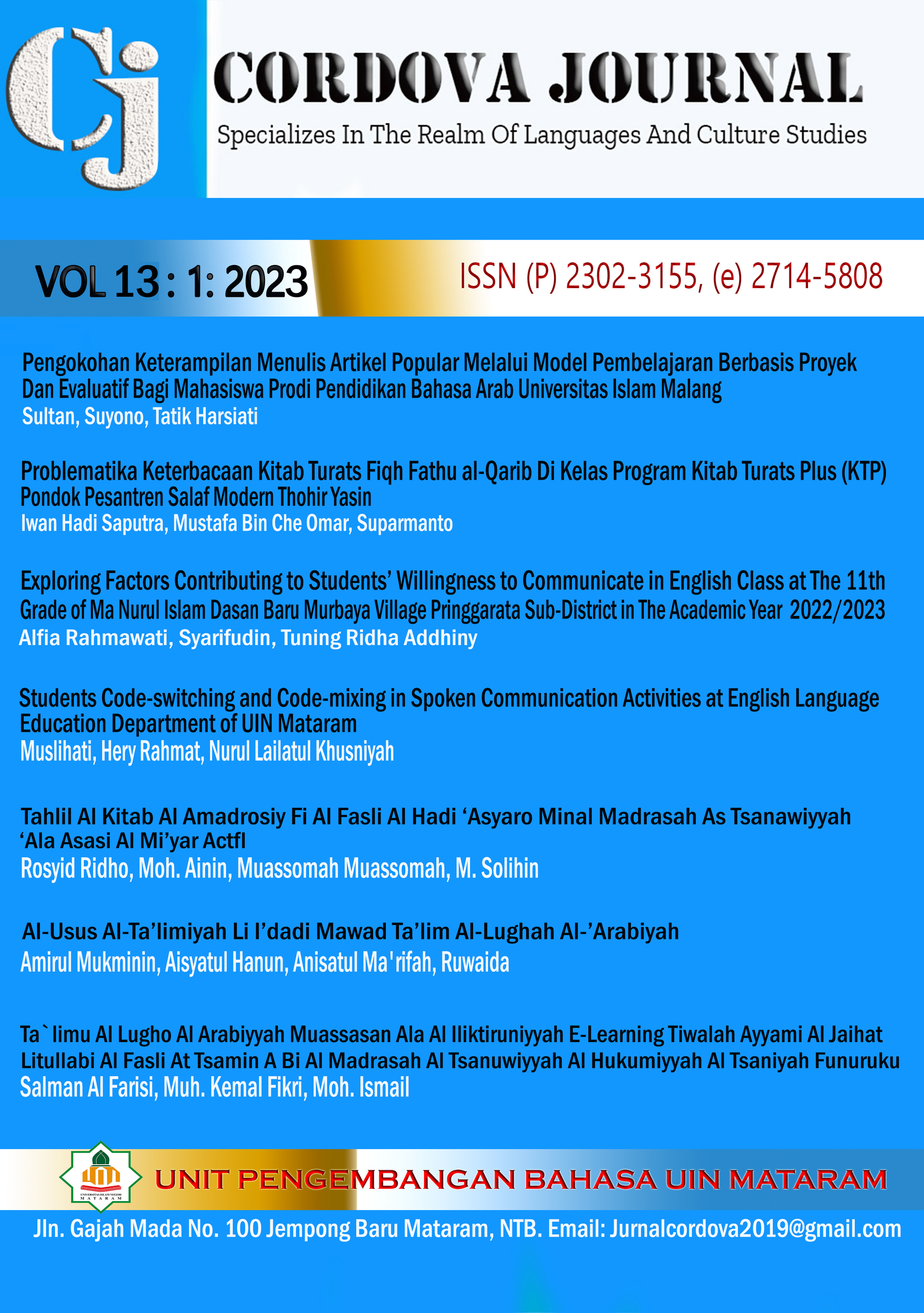
Exploring Factors Contributing to Students’ Willingness to Communicate in English Class at The 11th Grade of Ma Nurul Islam Dasan Baru Murbaya Village Pringgarata Sub-District in The Academic Year 2022/2023
DOI:
https://doi.org/10.20414/cordova.v13i1.7807Keywords:
Willingness to Communicate, WTC, English ClassAbstract
This research is aimed to find out the students’ willingness to communicate (WTC) in English class, and unveil the factors that contribute to students’ willingness to communicate (WTC) in English class. This research implemented qualitative descriptive method by conducting observation and interview. The informants were the 11th grade students at MA Nurul Islam Dasan Baru. The findings showed that most students have medium willingness to communicate in English class. Meanwhile, less of them have high willingness to communicate in English class. Furthermore, the researcher found some factors contributing to students’ willingness to communicate (WTC), namely psychological factors and situational factors. Psychological factors include self-confidence, perceive communicate competence, learning anxiety, motivation, and personality. Meanwhile, situational factors include effect of task, effect of topics, teacher role, interlocutor, and classroom atmosphere.
Downloads
References
Alimorad, Z., Farahmand, M., & Square, E. (2021). A Case Study On Willingness To Communicate In English In The Iranian. TEFLIN Journal, 32(1), 1–28.
Anwar, W., Jee, M. J., Adam, S., & Sailuddin, S. (2021). Willingness To Communicate And Its Influencing Factors Among Indonesian Pre-Service Teachers. JOLLT Journal of Languages and Language Teaching, 9(4), 385–398.
Azwar, T. A., Harahap, A., & Azwandi. (2021). Factors Influencing Indonesian EFL Learners ’ Willingness to Speak English in Classrooms. Journal of English Teaching, 7(2), 216–228.
Ebyary, K. El. (2021). The Impact of Online Interactive Tasks on L2 Willingness to Communicate?: the Case of Arabic Speaking Learners. April. https://doi.org/10.21608/mjat.2018.104636
Elwood, JA (2011). Enriching structural models of L2 willingness to communicate: The role of personality, ego permeability, and perceived distance. (Unpublished Doctoral Dissertation). Temple University. Philadelphia. Retrieved from https://digital.library.temple.edu/digital/collection/p 245801coll10
Havwini, T. (2019). Indonesian Efl Students ’ Willingness To Communicate In The 2013 Curriculum Implementation?: A Case Study Tian Havwini. 105–120.
Kang, S. (2005). Dynamic emergence of situational willingness to communicate in a second language. 33, 277–292. https://doi.org/10.1016/j.system.2004.10.004
Liu, MH (2005). Reticence in oral English language classrooms: A case study in China. TESL Reporter, 38(1), 1-16.
Maclntyre, P. D., & Baker, S. C. (2001). Willingness To Communicate . Social Language-Learning Orientations Of Immersion Students. May 2014. https://doi.org/10.1017/S0272263101003035
Mardiana, D. (2020). Investigating Students’ Willingness To Communicate In English: A Case Study Of Senior High School 12 In Pekanbaru.
Nazemi, M., & Rezvani, E. (2019). Effects of task familiarity and task repetition on Iranian EFL learners' engagement in L2 oral performance. Contemporary Research in Education and English Language Teaching, 1(1), 45-56.
Novawan, A., Aisyiyah, S., Miqawati, A. H., Wijayanti, F., & Indrastana, N. S. (2020). Exploring the Teachers’ Perspective on Morality in an English as a Foreign Language Pedagogy. Journal of ELT Research: The Academic Journal of Studies in English Language Teaching and Learning, 5(1), 80–93. https://doi.org/10.22236/JER
Peng, J. (2014). Willingness to communicate in Chinese EFL university classroom: An ecological perspective. Bristol: Multilingual Matters.
Qiuxuan, X. (2011). Willingness to Communicate in English Among Secondary School Students in the Rural Chineese English as a foreign Language (EFL) Classroom.
Sesriyani, L. (2020). The Indonesian Students ’ Willingness To Communicate In Virtual Class?: A Case Study. Journal GEEJ, 7(November). https://doi.org/10.46244/geej.v7i2.1191
Syarifudin. (2019). An Instrucational Model For Enhancing EFL Learners’ Speaking Proficiency. Journal of English Language Education, 2(1), 86–97.
Syarifudin, H. R. (2021). Intercultural Communication of EFL Students with Foreigners as a Strategy of Teaching Speaking. Journal of English Language Education, 4(1), 65–89.
Tuyen, L. Van, Th?, T., & Loan, T. (2019). Factors Affecting EFL Students ’ Willingness to Communicate in Speaking Classes at the Vietnamese Tertiary Level. International Journal of English Literature and Social Sciences (IJELS), 2.
Zaikalina, R. (2022). Students Autonomy Learnig English As Foreign Language During Distance Learning.
Additional Files
Published
Issue
Section
License
Copyright (c) 2023 Cordova Journal language and culture studies

This work is licensed under a Creative Commons Attribution 4.0 International License.

is licensed under a Creative Commons Attribution-ShareAlike 4.0 International License


