
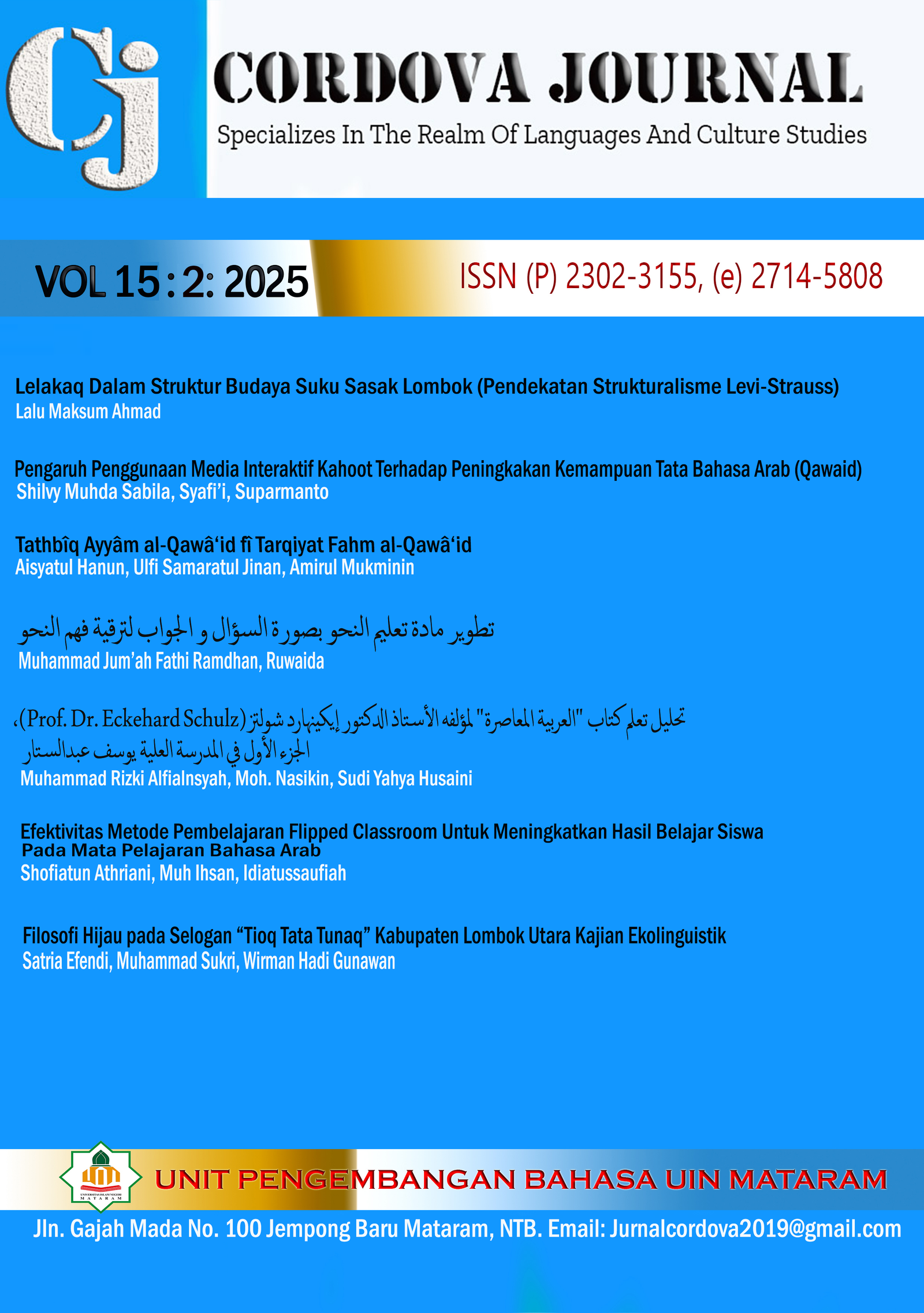
Lelakaq Dalam Struktur Budaya Suku Sasak Lombok (Pendekatan Strukturalisme Levi-Strauss)
DOI:
https://doi.org/10.20414/cordova.v2i2.14496Keywords:
Lelakaq; Sasak culture; Lombok; structuralism; Lévi-Strauss; oral tradition; Islamic spirituality; Sasak language; folklore; cosmology; local wisdom; cultural identityAbstract
Lelakaq, a traditional poetic form of the Sasak community in Lombok, represents a cultural expression that reflects the values, social structure, and spirituality of its people. This study explores the position of Lelakaq within the cosmology, traditions, and value systems of the Sasak society using Lévi-Strauss’s structuralist approach. Lelakaq functions not only as an aesthetic medium but also as an instrument for transmitting moral, religious, and social values across generations. The findings show that Lelakaq illustrates the relationship between humans and God (hablun minallah), social relations within the Sasak community (hablun minannas), and the connection between humans and nature (hablun minal ‘alam). This tradition also records historical journeys, legends, myths, and the cultural dynamics of the Sasak people—shaped by influences from Hindu-Buddhist traditions, Balinese culture, Majapahit, Islam, and local beliefs such as Wetu Telu and Sasak Boda. Furthermore, Lelakaq serves as a means of character education that instills the values of tindih (steadfastness), maliq (avoiding prohibitions), and merang (creativity and adaptability). Through linguistic symbols and metaphors, Lelakaq conveys guidance on ethics, Islamic spirituality, awareness of mortality, and harmonious social living. In addition, the diversity of Sasak dialects enriches the forms and styles of Lelakaq, reflecting the linguistic complexity and social identity of its speakers. This study concludes that Lelakaq functions as a cultural mirror of Sasak life, intertwining tradition, religion, history, and local wisdom. Thus, Lelakaq is not merely a literary heritage but also a value system that sustains the cultural identity of the Sasak people in the face of evolving times.
Downloads
References
Azra, A. (2004). The Origins of Islamic Reformism in Southeast Asia. Honolulu: University of Hawai‘i Press.
Cederroth, S. (1981). The Spell of the Ancestors and the Power of Mekkah: A Sasak Community on Lombok. Göteborg: Acta Universitatis Gothoburgensis.
Endraswara, S. (2013). Metodologi Penelitian Folklor: Konsep, Teori, dan Aplikasi. Yogyakarta: Media Pressindo.
Geertz, C. (1973). The Interpretation of Cultures. New York: Basic Books.
Ibrahim, A. S. (2014). Sastra Lisan Nusantara. Bandung: Kiblat Buku Utama.
Koentjaraningrat. (2002). Pengantar Ilmu Antropologi. Jakarta: Rineka Cipta.
Lombard, D. (2008). Nusa Jawa: Silang Budaya (Jilid 1–3). Jakarta: Gramedia.
Lelakaq karya TGKH..Zainuddin Abdul Madjid dalam buku Mulok Base Sasak kelas 2 Hal.75
Mahyuni. (2010). “Lelakaq Sasak: Kajian Bentuk, Fungsi, dan Nilai.” Jurnal Humaniora, 22(1).
Mulyadi, S. (2012). “Variasi Tutur Bahasa Sasak dalam Perspektif Sosiolinguistik.” Jurnal Linguistika Kultural, 4(1), 44–56.
Moleong, L. J. (2019). Metodologi Penelitian Kualitatif (Edisi Revisi). Bandung: Remaja Rosdakarya.
Proyek Penelitian dan pencatatan kebudayaan daerah Nusa Tenggara barat, Sejarah Daerah Nusa Tenggara Barat-Departemen Pendidikan dan kebudayaan Hal. : 7, 8.
Ratna, N. K. (2010). Teori, Metode, dan Teknik Penelitian Sastra. Yogyakarta: Pustaka Pelajar.
Suyatno, T. (2017). “Mitos dan Sistem Kepercayaan Lokal Masyarakat Sasak.” Jurnal Etnografi Indonesia, 5(1), 55–70.
Yusuf, W. (2015). “Legenda, Mitos, dan Tradisi Lisan Sasak.” Jurnal Kebudayaan Nusantara, 7(2), 88–102.
Wahidah,Lelakaq dalam Buku Kumpulan Lelakaq Pantun Sasak,(Mataram : Pemerintah Kota Mataram, 2024), 20.
Zuhdi, M. (2018). "Kosmologi dalam Tradisi Masyarakat Sasak." Jurnal Penelitian Kebudayaan, 12(2), 145–160.
Additional Files
Published
Issue
Section
License
Copyright (c) 2025 Lalu Maksum Ahmad

This work is licensed under a Creative Commons Attribution-NonCommercial-ShareAlike 4.0 International License.

is licensed under a Creative Commons Attribution-ShareAlike 4.0 International License


