
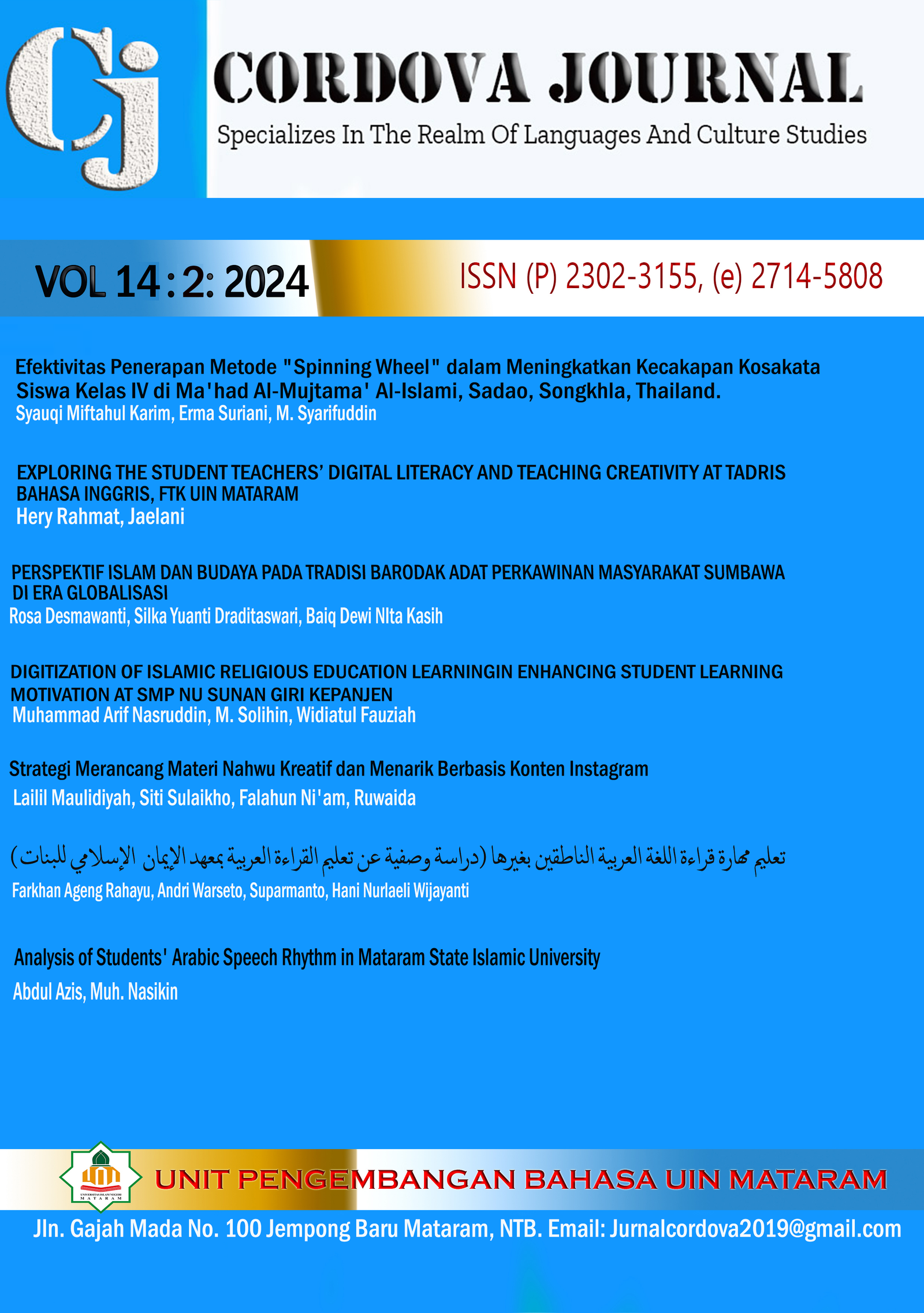
Analysis Of Students' Arabic Speech Rhythm In Mataram State Islamic University
DOI:
https://doi.org/10.20414/cordova.v14i2.12040Abstract
This paper seeks to explain how students enrolled in the Arabic Language Study Programme at the State Islamic University of Mataram acquire Arabic speech rhythm. The research method utilised was a quantitative descriptive method termed as a survey study which covered 91 respondents comprising of 45% males and 55% females and consisting of the 2020 (40%), 2021 (35%) and 2022 (25%). The findings indicated that around 15% of the respondents are found to be very excellent in the mastery of Arabic rhythms, 40% moderate, 30% poor mastery while 15% did not master Arabic rhythms at all. Other than the place of residence, the factors that contribute to the mastery of speech rhythm are educational background, training frequency and exposure to Arabic-language media where the respondents cited all three as contributing factors totalling 100%, with how many percent each contributing further indicating language barriers such as 40%, 35%, and 25% respectively. Bilingualism is crucial for pronunciation; however, students pointed out their inability to acquire accurate bilingualism as one of the reasons for the students’ deficient Arabic pronunciation, which also involves difficulties in controlling the tempo of pronunciation (50%), the syllables during pronunciation (30%), and acquiring an Arabic vocabulary (20%). Students wish for special training (45%), using audio/video learning media (30%), and receiving individual supervision (25%) in order to better their control of the speech rhythm. The study states that even though a reasonable number of students have acquired sufficient control of rhythm, a great number still have problems with controlling the appropriate timing and pressure when speaking. This calls for more natural and rhythmic Arabic speaking through more practical exercises and accompanying media.
Downloads
References
Abercrombie, David. (1967). Elements of General Phonetics. Edinburgh: Edinburgh University Press.
Boersma, P., & Weenink, D. (2013). Praat: Doing Phonetics by Computer. Glot International, 7(5), 341-345.
Fahrurrozi, A. (2014). PEMBELAJARAN BAHASA ARAB?: PROBLEMATIKA DAN SOLUSINYA. In A. Fahrurrozi, ARABIYAT Jurnal Pendidikan Bahasa Arab dan Kebahasaaraban (Vol. 1, Issue 2). Jakarta State Islamic University. https://doi.org/10.15408/a.v1i2.1137
Fletcher, Janet.(2010). ‘The prosody of speech: Timing and rhythm’.In William Hardcastle, John Laver,and Fiona Gibbon (eds.) The Handbook of Phonetic Sciences, 521–602.Oxford:Wiley-Blackwell.
Fowler, C. A. (1996). The Articulatory Interpretation of Gestural Phonology. In R. L. Allen (Ed.), Phonological Structure and Phonetic Form: Papers in Laboratory Phonology IV. Cambridge University Press.
Giles, H., & Coupland, N. (1991). Language: Contexts and Consequences. Open University Press.
Gussenhoven, C. (2004). The Phonology of Tone and Intonation. Cambridge: Cambridge University Press.
Halliday, M. A. K., & Greaves, W. S. (2008). Intonation in the Grammar of English. Equinox.
Hayes, B. (1995). Metrical Stress Theory: Principles and Case Studies. University of Chicago Press.
Henton, C. (1991). A Cross-Linguistic Study of Intonation and Rhythm. Language and Speech, 34(2), 189-213.
Jacewicz, E., et al. (2009). Cross-Dialectal Variations in Speech Rhythm: A Comparison of American English and Polish. Journal of Phonetics, 37(2), 122-135.
Jun, S. A. (2018). Prosodic Typology: The Phonology of Intonation and Phrasing. Oxford: Oxford University Press.
Jun, S.-A. (2005). Prosodic Typology: The Phonology of Intonation and Phrasing. Oxford University Press.
Ladd, D. R. (2008). Intonational Phonology. Cambridge University Press.
Ladefoged,Peterand Keith Johnson. (2015). A Course in Phonetics.7thedition. Stamford, Connecticut: Cengage Learning
McCarthy, J. J., & Prince, A. (1993). Generalized Alignment. In G. Booij & J. van Marle (Eds.), Yearbook of Morphology (pp. 1-65). Springer.
Mhemed, W. (2018). A Conceptual Framework for Mobile Application in Learning Arabic Language Proficiency. In W. Mhemed, The Journal of Social Sciences Research. https://doi.org/10.32861/jssr.spi4.66.70
Nespor, Marina, Mohinish Shukla, and Jacques Mehler.(2011). ‘Stress-timed vs. syllable-timed languages’.Invan Oostendorpet al. 1147–1160.
Pierrehumbert, J. B., & Hirschberg, J. (1990). The Intonational Structure of Discourse. The Linguistic Society of America, 2, 1-37.
Rahmawati, M., & Sumarlam, S. (2020). KAJIAN WACANA: PEMANFAATAN PRINSIP ANALOGI DALAM KUMPULAN CERKAK KEMBANG PASREN KARYA IMPIAN NOPITASARI (DISCOURSE ANALYSIS: THE APPLICATION OF THE ANALOGY CONCEPT IN SHORT STORIES SERIES KEMBANG PASREN BY IMPIAN NOPITASARI). In M. Rahmawati & S. Sumarlam, Metalingua Jurnal Penelitian Bahasa (Vol. 18, Issue 1, p. 75). https://doi.org/10.26499/metalingua.v18i1.367
Ritonga, M., Asrina, A., Widayanti, R., Alrasi, F., Julhadi, J., & Halim, S. (2020). Analisis Pembelajaran Bahasa Arab di Perguruan Tinggi dengan Mahasiswa Multi Agama. Dalam M. Ritonga, A. Asrina, R. Widayanti, F. Alrasi, J. Julhadi, & S. Halim, Jurnal Universal Penelitian Pendidikan (Vol. 8, Edisi 9, hlm. 4333). Penerbitan Penelitian Horison. https://doi.org/10.13189/ujer.2020.080960
Ritonga, M., Asrina, A., Widayanti,.. https://doi.org/10.13189/ujer.2020.080960
Ritonga, M., Nazir, A., & Wahyuni, S. (2016). Pembelajaran Bahasa Arab Berbasis Teknologi Informasi dan Komunikasi. Arabiyat: Jurnal Pendidikan Bahasa Arab Dan Kebahasaaraban, 3(1), 1–12. https://doi.org/http://dx.doi.org/10 .15408/a.v3i1.2879
Schneider, E. W. (2008). English Around the World: An Introduction. Cambridge University Press.
Selkirk, E. (1984). Phonology and Syntax: The Relation between Sound and Structure. MIT Press.
Smith, C. L. (2003). The Role of Rhythm in Speech Perception and Production. Journal of Phonetics, 31(1), 1-30.
Tilsen, S., & Johnson, K. (2008, July 18). Low-frequency Fourier analysis of speech rhythm. In S. Tilsen & K. Johnson, The Journal of the Acoustical Society of America (Vol. 124, Issue 2). Acoustical Society of America. https://doi.org/10.1121/1.2947626
van der Hulst, H. (2010). The Prosodic System of Languages: Typological Considerations. In A. Cohn, C. Fougeron, & M. K. Huffman (Eds.), The Handbook of Laboratory Phonology (pp. 198-222). Oxford University Press.
Additional Files
Published
Issue
Section
License
Copyright (c) 2024 Abdul Azis Azis, Moh Nasikin

This work is licensed under a Creative Commons Attribution-NonCommercial-ShareAlike 4.0 International License.

is licensed under a Creative Commons Attribution-ShareAlike 4.0 International License


